Math, Science, and Engineering Handbook

Daniel Kelley

October 28, 2023

Chapter 1 Math

1.1 Integrals

.
1 \( \int {x^n} \,dx = \frac {x^{n+1}}{n+1} \)
2 \( \int {\frac {dx}{x}} = ln{x} \)
3 \( \int {e^x} \,dx = e^x \)
4 \( \int {cos(x)} \,dx = sin(x) \)
5 \( \int {sin(x)} \,dx = -cos(x) \)
6 \( \int {sec^{2}(x)} \,dx = tan(x) \)
7 \( \int {csc^{2}(x)} \,dx = -cot(x) \)
8 \( \int {sec(x) \cdot tan(x)} \,dx = sec(x) \)
9 \( \int {csc(x) \cdot cot(x)} \,dx = -csc(x) \)
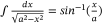
10 \( \int {\frac {dx}{\sqrt {a^2 - x^2}}} = sin^{-1}(\frac {x}{a}) \)
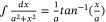
11 \( \int {\frac {dx}{a^2 + x^2}} = \frac {1}{a} tan^{-1}(\frac {x}{a}) \)
12 \( \int {tan(x)} \,dx = -ln(cos(x)) \)
13 \( \int {cot(x)} \,dx = ln(sin(x)) \)
14 \( \int {sec(x)} \,dx = ln(sec(x)+tan(x)) \)
15 \( \int {csc(x)} \,dx = -ln(csc(x)+cot(x)) \)

1.2 Formulas

.
Quadratic Approximation \( f(u+x) ~= f(u) + f'(u) \cdot x + f''(u) \cdot x^2 / 2 \)
\( FTC2 \) \( d/dx \int _0^x f(t) dt = f(x) \)
\( FTC2 \) Chain Rule \( d/dx \int _0^{g(x)} f(t) dt = g'(x) \cdot f(g(x)) \)
Weighted Average \( \int _a^b f(x) w(x) dx / \int _a^b w(x) dx \)

1.3 Lโ€™Hรดpitalโ€™s Rule

\[ \lim _{x \to a} f(x)/g(x) = \lim _{x \to a} f'(x)/g'(x)   \]

.
\( 0/0 \) Straight up
\( \infty /\infty \) Straight up
\( 0 \cdot \infty \) Rewrite as quotient
\( 0^0 \) Rewrite as \( e^{ln(f)} \)
\( \infty ^0 \) Rewrite as \( e^{ln(f)} \)
\( 1^\infty \) Rewrite as \( e^{ln(f)} \)
\( \infty - \infty \) Good luck
Otherwise Forget it.

1.4 Vector Products

Dot Product

(-tikz- diagram)

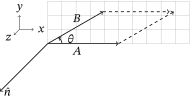
Figure 1: Dot Product

\( \vec {A}\cdot \vec {B} = \left |\vec {A}\right |\left |\vec {B}\right |cos(\theta ) \)

The scalar value of the dot product is the sum of the product of the vector components \( \Sigma \, a_i \cdot b_i \)

Geometrically, the scalar value is the length of the projection of \( \vec {B} \) onto \( \vec {A} \).

Cross Product

(-tikz- diagram)

Figure 2: Cross Product

\( \vec {A}\times \vec {B} = \left |\vec {A}\right |\left |\vec {B}\right |sin(\theta )\hat {n} \)

Geometrically, the vector value of the cross product is the area of the parallelogram formed by \( \vec {B} \) and \( \vec {A} \) times the unit vector \( \hat {n} \) normal to the plane of the parallelogram following the right hand rule.

Special Values
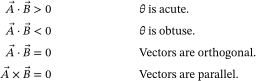
(1.1โ€“0) \{begin}{align*} \vec {A}\cdot \vec {B} &>0&&\theta \text { is acute.} \\ \vec {A}\cdot \vec {B} &<0&&\theta \text { is obtuse.} \\ \vec
{A}\cdot \vec {B} &=0&&\text {Vectors are orthogonal.} \\ \vec {A}\times \vec {B} &=0&&\text {Vectors are parallel.} \\ \{end}{align*}

1.5 Parametric Vector Calculus

.
Position \( \vec {r}(t)=x(t)\hat {i}+y(t)\hat {j} \) \( \int \vec {v}(t) dt \)
Velocity \( d\vec {r}(t)/dt \) \( \vec {v}(t)=x'(t)\hat {i}+y'(t)\hat {j} \) \( \int \vec {a}(t) dt \) \( \frac {ds}{dt} \vec {T} \)
Acceleration \( d\vec {v}(t)/dt \) \( d^2\vec {r}(t)/dt^2 \) \( \vec {v}(t)=x''(t)\hat {i}+y''(t)\hat {j} \)
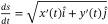
Arc Length \( \frac {ds}{dt} = \sqrt {x'(t)\hat {i}+y'(t)\hat {j}} \)
Unit Tangent \( \hat {T}=\vec {v}/\left | \vec {v} \right | \)

1.6 Partial Differentiation

.
Tangent Plane to \( f(x_{0},y_{0}) \) \( z-z_0 =(\frac {\partial {f}}{\partial {x}})_{x_{0}}(x-x_0) + (\frac {\partial {f}}{\partial {y}})_{y_{0}}(y-y_0) \)
Approximation \( f(x,y)=z_0 + \frac {\partial {f}}{\partial {x}}(x-x_0) + \frac {\partial {f}}{\partial {y}}(y-y_0) \)

1.7 Least Square Line

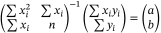
\( \begin {pmatrix} \sum x_i^2 & \sum x_i \\ \sum x_i & n \\ \end {pmatrix}^{-1} \begin {pmatrix} \sum x_i y_i \\ \sum y_i \\ \end {pmatrix} = \begin {pmatrix} a \\ b \\ \end
{pmatrix} \)for \( y = ax + b \) given \( n \) points \( (x_i,y_i) \)

1.8 Second Derivative Test

Given \( f(x,y) \) critical points \( (x_c,y_c) \) where \( \frac {\partial {f}}{\partial {x}}=0 \) and \( \frac {\partial {f}}{\partial {y}}=0 \)

.
\( A = \frac {\partial ^2{f}}{\partial {x}^2}@(x_c,y_c) \)
\( B = \frac {\partial ^2{f}}{\partial {x}\partial {y}}@(x_c,y_c) \)
\( C = \frac {\partial ^2{f}}{\partial {y}^2}@(x_c,y_c) \)
.
\( AC-B^2 > 0 \) , \( A>0 \) or \( C>0 \) Minimum point
\( AC-B^2 > 0 \) , \( A<0 \) or \( C<0 \) Maximum point
\( AC-B^2 < 0 \) Saddle point
\( AC-B^2 = 0 \) Need higher order terms to conclude

1.9 Differential Chain Rule

\( f(x(t),y(t),z(t)) \); \( \frac {df}{dt}= f_{x}\frac {dx}{dt} + f_{y}\frac {dy}{dt} + f_{z}\frac {dz}{dt} \)

1.10 Level Curves and Surfaces

The level curve for a function \( f(x,y) \) is the set of points \( (x,y) \) where \( f(x,y)=C \) for constant \( C \).

1.11 Gradient

The gradient \( \nabla {f} \) of (potential) function \( f \) is a vector of the partial derivatives of \( f \) for each independant variable; e.g. \( \nabla f(x,y) = \langle f_x,f_y \rangle \). \( \nabla {f} \perp f(x,y) \), i.e. gradient \( \perp \) level curve.

The directional derivitive of \( f \) at the point \( P \) in the direction of \( \vec {u} \) is \( \frac {df}{ds}\biggr \rvert _{P,\vec {u}}=\nabla {f}(P)\cdot \vec {u} \).

Given an objective function \( f \) and a constraint function \( g=C \) for constant \( C \), the extrema of \( f \) are found when \( \nabla {f} \parallel \nabla {g} \). The Lagrange multiplier \( \lambda \) is \( \frac {\nabla {f}}{\nabla {g}} \).

1.12 Center of Mass

.
\( M \) Mass
\( \delta \) Density Function
\( \bar {x} \) \( x \) center
\( \bar {y} \) \( y \) center

(1.1โ€“0) \{begin}{align*} M&=\int \int _R{\delta } \,dA\\ \bar {x}&=\frac {1}{M}\int \int _R{x\delta } \,dA\\ \bar {y}&=\frac {1}{M}\int \int _R{y\delta } \,dA\\
\{end}{align*}

1.13 Moment of Inertia

.
\( I_x \) Moment about \( x \) axis
\( I_y \) Moment about \( y \) axis

(1.1โ€“0) \{begin}{align*} I_x&=\int \int _R{\delta }y^2 \,dy\\ I_y&=\int \int _R{\delta }x^2 \,dx\\ \{end}{align*}

1.14 Change of Variables

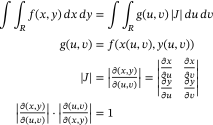
(1.1โ€“0) \{begin}{align*} \int \int _R{f(x,y) \,dx \,dy} &=\int \int _R{g(u,v)\, |J| \,du \,dv} \\ g(u,v) &= f(x(u,v),y(u,v)) \\ |J| &= \begin{vmatrix} \frac {\partial
{(x,y)}}{\partial {(u,v)}}\\ \end {vmatrix} = \begin{vmatrix} \frac {\partial {x}}{\partial {u}} & \frac {\partial {x}}{\partial {v}}\\ \frac {\partial {y}}{\partial {u}} & \frac
{\partial {y}}{\partial {v}}\\ \end {vmatrix} \\ \begin{vmatrix} \frac {\partial {(x,y)}}{\partial {(u,v)}}\\ \end {vmatrix} \cdot \begin{vmatrix} \frac {\partial {(u,v)}}{\partial {(x,y)}}
\end {vmatrix} &= 1 \{end}{align*}

1.15 Vector Field

.
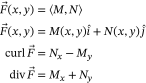
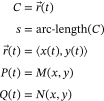
\( \vec {F} \) Field
\( M \) Field component in \( x \) direction (\( \hat {i} \)) \( F_x \)
\( N \) Field component in \( y \) direction (\( \hat {j} \)) \( F_y \)
\( C \) Curve \( \vec {r}(t) \) = \( \langle x(t),y(t) \rangle \)

(1.1โ€“0) \{begin}{align*} \vec {F}(x,y) &= \langle M,N \rangle \\ \vec {F}(x,y) &= M(x,y)\hat {i} + N(x,y)\hat {j}\\ \text {curl}\,\vec {F} &= N_x - M_y \\ \text
{div}\,\vec {F} &= M_x + N_y \\ \{end}{align*}

1.16 Rectangular/Polar Conversion

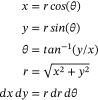
(1.1โ€“0) \{begin}{align*} x &= r\,cos(\theta ) \\ y &= r\,sin(\theta ) \\ \theta &= tan^{-1}(y/x) \\ r &= \sqrt {x^2+y^2} \\ dx\,dy &= r\,dr\,d\theta \\
\{end}{align*}

1.17 Complex Arithmetic

(1.1โ€“0) \{begin}{align*} i &= \sqrt {-1} && \text {Imaginary unit} \\ z &= a + bi && \text {Complex number z} \\ \bar {z} &= a - bi && \text
{Complex congugate} \\ a &= Re(a + bi) && \text {Real part} \\ b &= Im(a + bi) && \text {Imaginary part} \\ (a+bi)+(c+di) &= (a+c) + (b+d)i && \text
{Addition} \\ (a+bi)\cdot (c+di) &= (ac-bd) + (ad+bc)i && \text {Multiplication} \\ \frac {a+bi}{c+di} &= \frac {(ac+bd) + (bc-ad)i}{c^2+d^2} && \text {Division} \\
\abs {z} &= \sqrt {a^2+b^2} && \text {Absolute value, Modulus} \\ arg(z) &= tan^{-1}(b/a) = \theta && \text {Argument} \\ z\bar {z} &= \abs {z}^2 && \text
{Modulus squared} \\ e^{i\theta } &= cos(\theta ) + i\,sin(\theta ) && \text {Euler's Formula} \\ z &= \abs {z}[cos(\theta ) + i\,sin(\theta )] && \text {Polar
form I} \\ z &= \abs {z}e^{i\theta } && \text {Polar form II} \\ \{end}{align*}

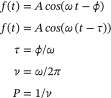
1.18 Sinusoidal Functions

.
\( A \) Amplitude
\( \omega \) Angular Frequency
\( \phi \) Phase lag
\( \tau \) Time delay
\( \nu \) Frequency
\( P \) Period

(1.1โ€“0) \{begin}{align*} f(t) &= A\,cos(\omega \,t - \phi ) \\ f(t) &= A\,cos(\omega \,(t - \tau )) \\ \tau &= \phi / \omega \\ \nu &= \omega / 2\pi \\ P &= 1/\nu
\\ \{end}{align*}

1.19 Sinusoidal Identity

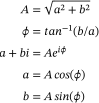
(1.1โ€“0) \{begin}{align*} a\,cos(\omega \,t)+b\,sin(\omega \,t) &= A\,cos(\omega \,t - \phi ) \{end}{align*}

.
\( a\,cos(\omega \,t)+b\,sin(\omega \,t) \) Rectangular (Cartesian) form
\( A\,cos(\omega \,t - \phi ) \) Amplitude-phase form

(1.1โ€“0) \{begin}{align*} A &= \sqrt {a^2+b^2} \\ \phi &= tan^{-1}(b/a) \\ a+bi &= Ae^{i\phi } \\ a &= A\,cos(\phi ) \\ b &= A\,sin(\phi ) \{end}{align*}

(-tikz- diagram)

Figure 3: \( a+bi=Ae^{i\phi } \)

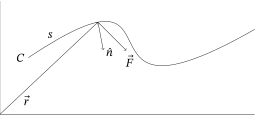
1.20 Line Integral

(1.1โ€“0) \{begin}{align*} C &=\vec {r}(t) \\ s &= \text {arc-length}(C) \\ \vec {r}(t) &=\langle x(t),y(t) \rangle \\ P(t) &= M(x,y) \\ Q(t) &= N(x,y) \\
\{end}{align*}

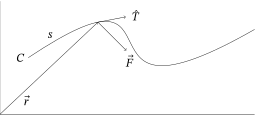
Work

Force on particle along a curve.
(-tikz- diagram)

Figure 4: Work

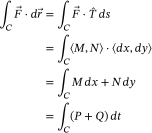
(1.1โ€“0) \{begin}{align*} \int _C \vec {F} \cdot d\vec {r} &= \int _C \vec {F} \cdot \hat {T} \, ds \\ &= \int _C \langle M,N \rangle \cdot \langle dx,dy \rangle \\ &=
\int _C M\,dx + N\,dy \\ &= \int _C (P + Q) \,dt \\ \{end}{align*}

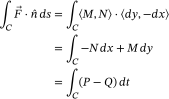
Flow

Flow across a curve.

(-tikz- diagram)

Figure 5: Flow

(1.1โ€“0) \{begin}{align*} \int _C \vec {F}\cdot \hat {n}\,ds &= \int _C \langle M,N \rangle \cdot \langle dy,-dx \rangle \\ &= \int _C -N\,dx + M\,dy \\ &= \int _C (P - Q)
\,dt \\ \{end}{align*}

Area

Area of a simply connected closed curve.
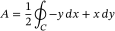
(1.1โ€“0) \{begin}{align*} A &= \frac {1}{2} \oint _C -y\,dx + x\,dy \\ \{end}{align*}

1.21 Gradient Field

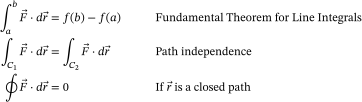
If \( \vec {F}(x,y) == \nabla {f} \) then the field \( \vec {F} \) is conservative.

(1.1โ€“0) \{begin}{align*} \int _a^b \vec {F} \cdot d\vec {r} &= f(b) - f(a) && \text {Fundamental Theorem for Line Integrals}\\ \int _{C_1} \vec {F} \cdot d\vec {r} &=
\int _{C_2} \vec {F} \cdot d\vec {r} && \text {Path independence}\\ \oint \vec {F} \cdot d\vec {r} &= 0 && \text {If $\vec {r}$ is a closed path}\\ \{end}{align*}

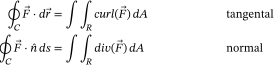
1.22 Greenโ€™s Theorem

(1.1โ€“0) \{begin}{align*} \oint _C \vec {F} \cdot d\vec {r} &= \int \int _R curl(\vec {F})\,dA && \text {tangental} \\ \oint _C \vec {F} \cdot \hat {n}\, ds &= \int
\int _R div(\vec {F})\,dA && \text {normal} \\ \{end}{align*}

1.23 Differential Equations

Separation of Variables
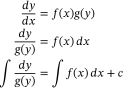
(1.1โ€“0) \{begin}{align*} \frac {dy}{dx} &= f(x)g(y) \\ \frac {dy}{g(y)} &= f(x)\,dx \\ \int {\frac {dy}{g(y)}} &= \int {f(x)}\,dx+c \\ \{end}{align*}

Integrating Factors

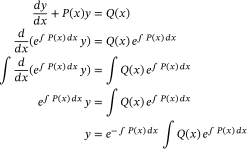
(1.1โ€“0) \{begin}{align*} \frac {dy}{dx} + P(x)y &= Q(x) \\ \frac {d}{dx}(e^{\int \,P(x)\,dx}\,y) &= Q(x)\,e^{\int \,P(x)\,dx} \\ \int {\frac {d}{dx}(e^{\int \,P(x)\,dx}\,y)}
&= \int {Q(x)\,e^{\int \,P(x)\,dx}} \\ e^{\int \,P(x)\,dx}\,y &= \int {Q(x)\,e^{\int \,P(x)\,dx}} \\ y &= e^{-\int \,P(x)\,dx}\,\int {Q(x)\,e^{\int \,P(x)\,dx}} \\ \{end}{align*}

Step and Delta Functions

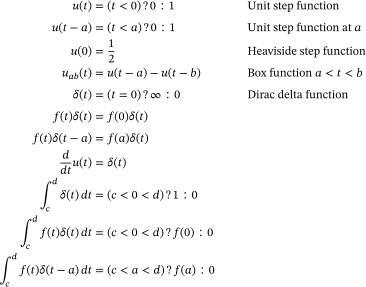
(1.1โ€“0) \{begin}{align*} u(t) &= (t<0) \,?\, 0 : 1 && \text {Unit step function}\\ u(t-a) &= (t<a) \,?\, 0 : 1 && \text {Unit step function at $a$}\\
u(0) &= \frac {1}{2} && \text {Heaviside step function}\\ u_{ab}(t) &= u(t-a) - u(t-b) && \text {Box function $a<t<b$}\\ \delta (t) &= (t=0)\,?\,\infty : 0
&& \text {Dirac delta function}\\ f(t)\delta (t) &= f(0)\delta (t) \\ f(t)\delta (t-a) &= f(a)\delta (t) \\ \frac {d}{dt}u(t) &= \delta (t)\\ \int _c^d \delta (t)\,dt
&= (c<0<d)\,?\,1:0 \\ \int _c^d f(t)\delta (t)\,dt &= (c<0<d)\,?\,f(0):0 \\ \int _c^d f(t)\delta (t-a)\,dt &= (c<a<d)\,?\,f(a):0 \\ \{end}{align*}

1.24 Fourier Series

Fourier Coefficients
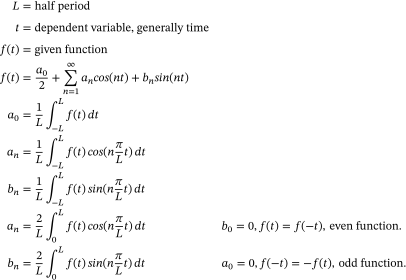
(1.1โ€“0) \{begin}{align*} L &= \text {half period}\\ t &= \text {dependent variable, generally time} \\ f(t) &= \text {given function}\\ f(t) &= \frac {a_{0}}{2} +
\sum _{n=1}^{\infty } a_ncos(nt) + b_nsin(nt)\\ a_0 &= \frac {1}{L} \int _{-L}^{L} f(t)\,dt\\ a_n &= \frac {1}{L} \int _{-L}^{L} f(t)\,cos(n\frac {\pi }{L}t)\,dt \\ b_n &= \frac
{1}{L} \int _{-L}^{L} f(t)\,sin(n\frac {\pi }{L}t)\,dt \\ a_n &= \frac {2}{L} \int _{0}^{L} f(t)\,cos(n\frac {\pi }{L}t)\,dt && b_0=0, f(t)=f(-t),\,\text {even function.} \\ b_n
&= \frac {2}{L} \int _{0}^{L} f(t)\,sin(n\frac {\pi }{L}t)\,dt && a_0=0, f(-t)=-f(t),\,\text {odd function.} \\ \{end}{align*}

1.25 Laplace Transform

Definitions

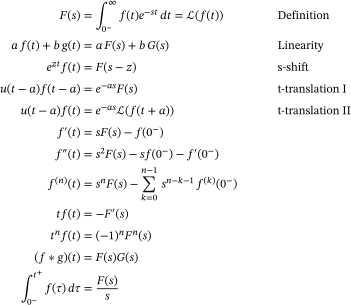
(1.1โ€“0) \{begin}{align*} F(s) &= \int _{0^-}^{\infty }f(t)e^{-st}\,dt = \mathcal {L}(f(t)) && \text {Definition}\\ a\,f(t) + b\,g(t) &= a\,F(s) + b\,G(s) &&
\text {Linearity}\\ e^{zt}f(t)&= F(s-z) && \text {s-shift} \\ u(t-a)f(t-a)&= e^{-as}F(s) && \text {t-translation I} \\ u(t-a)f(t)&= e^{-as}\mathcal {L}(f(t+a))
&& \text {t-translation II} \\ f'(t) &= sF(s) - f(0^{-}) \\ f''(t) &= s^{2}F(s) - sf(0^{-}) - f'(0^{-}) \\ f^{(n)}(t) &= s^{n}F(s) - \sum
_{k=0}^{n-1}\,s^{n-k-1}\,f^{(k)}(0^{-}) \\ tf(t) &= -F'(s) \\ t^{n}f(t) &= (-1)^{n}F^{n}(s) \\ (f*g)(t)&= F(s)G(s) \\ \int _{0^-}^{t^+} f(\tau )\,d\tau &= \frac {F(s)}{s}
\\ \{end}{align*}

Transforms

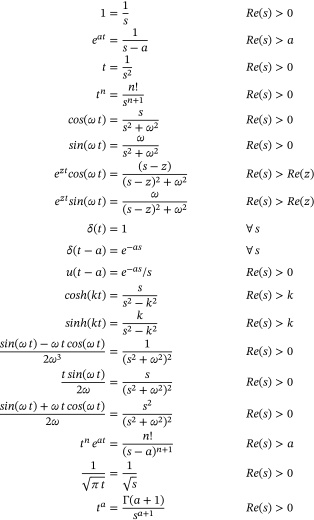
(1.1โ€“0) \{begin}{align*} 1 &= \frac {1}{s} && Re(s) > 0\\ e^{at} &= \frac {1}{s-a} && Re(s) > a\\ t &= \frac {1}{s^2} && Re(s) > 0\\ t^n
&= \frac {n!}{s^{n+1}} && Re(s) > 0\\ cos(\omega \,t) &= \frac {s}{s^2+\omega ^2} && Re(s) > 0\\ sin(\omega \,t) &= \frac {\omega }{s^2+\omega ^2} &&
Re(s) > 0\\ e^{zt}cos(\omega \,t) &= \frac {(s-z)}{(s-z)^2+\omega ^2} && Re(s) > Re(z)\\ e^{zt}sin(\omega \,t) &= \frac {\omega }{(s-z)^2+\omega ^2} && Re(s) >
Re(z)\\ \delta (t) &= 1 && \forall \,s\\ \delta (t-a) &= e^{-as} && \forall \,s\\ u(t-a)&= e^{-as}/s && Re(s) > 0\\ cosh(kt) &= \frac {s}{s^2-k^2}
&& Re(s) > k\\ sinh(kt) &= \frac {k}{s^2-k^2} && Re(s) > k\\ \frac {sin(\omega \,t)-\omega \,t\,cos(\omega \,t)}{2\omega ^3} &= \frac {1}{(s^2+\omega ^2)^2}
&& Re(s) > 0\\ \frac {t\,sin(\omega \,t)}{2\omega } &= \frac {s}{(s^2+\omega ^2)^2} && Re(s) > 0\\ \frac {sin(\omega \,t)+\omega \,t\,cos(\omega \,t)}{2\omega }
&= \frac {s^2}{(s^2+\omega ^2)^2} && Re(s) > 0\\ t^n\,e^{at} &= \frac {n!}{(s-a)^{n+1}} && Re(s) > a\\ \frac {1}{\sqrt {\pi \,t}} &= \frac {1}{\sqrt {s}}
&& Re(s) > 0\\ t^a &= \frac {\Gamma (a+1)}{s^{a+1}} && Re(s) > 0\\ \{end}{align*}

Heaviside Coverup

Decomposition of Laplace transforms into partial fractions. Denominator must be distinct linear factors.
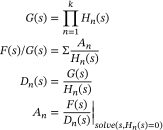
(1.1โ€“0) \{begin}{align*} G(s) &= \prod \limits _{n=1}^{k} H_n(s)\\ F(s)/G(s) &= \Sigma \frac {A_n}{H_{n}(s)}\\ D_{n}(s) &=\frac {G(s)}{H_n(s)}\\ A_n &= \frac
{F(s)}{D_{n}(s)} \biggr \rvert _{solve(s,H_{n}(s)=0)}\\ \{end}{align*}

Chapter 2 Science

2.1 Units

.
Quantity MKS Name Abbrev.
Angle radian rad
Solid Angle steradian \( sr \)
Area \( m^2 \)
Volume \( m^3 \)
Frequency \( s^{-1} \) Hertz \( Hz \)
Velocity \( m \cdot s^{-1} \)
Acceleration \( m \cdot s^{-2} \)
Angular Velocity \( rad \cdot s^{-1} \)
Angular Acceleration \( rad \cdot s^{-2} \)
Density \( kg \cdot m^{-3} \)
Momentum \( kg \cdot m \cdot s^{-1} \)
Angular Momentum \( kg \cdot m^2 \cdot s^{-1} \)
Force \( kg \cdot m \cdot s^{-2} \) Newton \( N \)
Work, Energy \( kg \cdot m^2 \cdot s^{-2} \) Joule \( J \)
Power \( kg \cdot m^2 \cdot s^{-3} \) Watt \( W \)
Torque \( kg \cdot m^2 \cdot s^{-2} \)
Pressure \( kg \cdot m^{-1} \cdot s^{-2} \) Pascal \( Pa \)

2.2 Lab Reports

.
Abstract
Objective
Method
Data
Analysis
Conclusion
Bibliography

2.3 Laws

.
Newtonโ€™s 1st Law \( \sum \mathbf {F} = 0 \Leftrightarrow \dot {\mathbf {v}} \)
Newtonโ€™s 2nd Law \( \mathbf {F} = m\mathbf {a} = \dot {\mathbf {p}} \)
Newtonโ€™s 3rd Law \( \mathbf {F}_a = -\mathbf {F}_a \)
Gravity \( \mathbf {F} = m\mathbf {g} \); \( \mathbf {g}=9.81 \) m/s
Hookeโ€™s Law \( F_x = -k\Delta x \); \( k= \) spring constant
Force \( N = kg \cdot m \cdot s^{-2} \)
Energy \( J = N \cdot m \)
Power \( W = J \cdot s^{-1} \)
Momentum \( \mathbf {p} = m \cdot \mathbf {v} \)
Kinetic Energy \( K=\tfrac {1}{2}m\mathbf {v}^2=\frac {\mathbf {p}^2}{2m} \)
Momentum is conserved
Energy is conserved

2.4 Mechanics Problem Workflow

.
Draw a good picture.
Decorate with forces with a free body diagram for each body.
Choose a suitable coordinate system.
Decompose forces on each body.
Determine acceleration for each body.
Determine 1d equations of motion for each body, including necessary constraints.
Reconstruct multidimensional motion vectors.
Algebraically determine kinematics as needed.

Chapter 3 Engineering

3.1 DC Ohmโ€™s Law

.
\( I \) \( =\frac {E}{R} \) \( =\frac {P}{E} \) \( =\sqrt {\frac {P}{R}} \)
\( R \) \( =\frac {E}{I} \) \( =\frac {E^2}{P} \) \( =\frac {P}{I^2} \)
\( E \) \( =IR \) \( =\frac {P}{I} \) \( =\sqrt {PR} \)
\( P \) \( =EI \) \( =I^2R \) \( =\frac {E^2}{R} \)

3.2 AC Ohmโ€™s Law

.
\( I \) \( =\frac {E}{Z} \) \( =\frac {P}{E cos(\theta )} \) \( =\sqrt {\frac {P}{Z cos(\theta )}} \)
\( Z \) \( =\frac {E}{I} \) \( =\frac {E^2 cos(\theta )}{P} \) \( =\frac {P}{I^2 cos(\theta )} \)
\( E \) \( =IZ \) \( =\frac {P}{I cos(\theta )} \) \( =\sqrt {\frac {PZ}{cos(\theta )}} \)
\( P \) \( =EI cos(\theta ) \) \( =I^2Z cos(\theta ) \) \( =\frac {E^2 cos(\theta )}{Z} \)

Bibliography

  • [1]  Robert G. Brown, Introductory Physics I. http://webhome.phy.duke.edu/ rgb/Class/intro-physics-1/intro-physics-1.pdf

  • [2]  Allied Radio Corporation, Alliedโ€™s Electronics Data Handbook. https://archive.org/details/AlliedsElectronicsDataHandbook